
When it came time to change Momo’s rig a few years ago, I decided to try something different. I had re-rigged the boat twice before, once when she was purchased in Los Angeles and the second time in New Zealand. I was now in the Sea of Cortez, and even though her rig looked great, it was more than ten years old and had sailed many thousands of miles. The easiest thing would have been to stay with the devil you know and re-rig her with stainless steel. But in the stomach of every experienced sailor there is a dark little anxious knot that comes from knowing that stainless steel is a treacherous servant. It is a knowledge that grows steadily over time with every stainless bolt that snaps, toggle that breaks, and stanchion base that crumbles, and with every story about a mast that suddenly came down. There but for the grace of God ….
For this reason, I wanted to find an alternative to stainless steel rigging that would work for me. I did a lot of research; it took a lot of time; and I learned a lot of things. Momo’s “new” galvanized steel rig is now more than two years old and has covered around 8,500 nautical miles. The rig is safer, stronger, and has less stretch than your typical rig made of 316 (i.e., marine grade) stainless steel. And it cost a fraction of the price. I think it’s worth sharing how we got there.

Let’s start with the problems of stainless
It is a well-known fact that, along with being susceptible to work-hardening, which makes it brittle and leads to stress corrosion cracking, stainless steel is particularly vulnerable to pitting and crevice corrosion. The latter generally occur in areas starved of oxygen, which usually means places you cannot see. All of these factors can result in sudden catastrophic failure. Feel the anxiety? The swaged fittings typically used on sailboat rigging, which are installed by third parties (i.e., rigging shops, etc.), introduce additional vulnerabilities to the mix, some of which are beyond your control. All told, a stainless steel rig is difficult – if not virtually impossible – to properly inspect. This is why recommendations for when rigs should be replaced are generally expressed in intervals of time.
It’s said that you should change the rigging every 10 to 15 years depending on how heavily it is used. But such criteria are inherently vague and little more than an expression of probabilities. If your rig is new, it probably won’t fail. But if it is more than ten years old, it is far more likely that it will, no matter how good it looks. It’s worth noting that this 10- to 15-year period now applies to Sta-Lok fittings too. Mechanical fittings such as Sta-Loks are superior to swaged fittings and easy to install on your own. Although they are much more expensive, they once were touted as being indefinitely reusable, which made them quite attractive. But this is no longer the case. Sta-Lok now states that they should only be used for the “lifetime of the rigging”, which makes re-rigging a boat with Sta-Loks a very expensive proposition.


My own experience with stainless steel rigging has been mixed. I re-rigged the boat when it was purchased, going up a size from the designer’s specifications. I bought the wire from Rigging Only, a perfectly reputable company. Within less than four years, I started discovering checks in Momo’s 5/16” cables – for the first time in Tonga when we were inspecting the rig prior to a passage to New Zealand. Then in New Zealand, I found circles of pitting – like neat perforations – on Momo’s 3/8” backstay underneath the plastic zip ties used to secure the standoffs for the SSB antenna. This is not the kind of thing one want to see.


I rigged the boat again in New Zealand, and this time the results were much better. Ten years later, in the Sea of Cortez, it still appeared almost new. I opened the Sta-Loks to discover that the ends looked perfect. However, I did find some pitting on the mast tangs, which came as a surprise. But that is the problem with stainless – its propensity to deliver the unexpected. Particularly notable, however, is that my ten-year-old stainless looked much better than a lot of the rusty stuff I was seeing on Canadian and US boats that was less than one year old. This is frequently dismissed as tea-staining, surface contamination, and the result improper maintenance. But my rigging from New Zealand always looked absolutely great without anyone ever having to take a cloth to it, so one wonders what’s truly going on. Add to this the disturbing number of reports of rigging failure and dismastings, which genuinely seem to have increased recently, and you’re not left with a lot of reasons to put your faith in stainless steel.


Synthetic rigging (Dyneema)
One increasingly popular alternative to stainless steel is synthetic rigging – i.e., Dyneema. Its major advantages are that it’s very light and doesn’t corrode. I am not so keen on it because of its vulnerability to chafe. I suspect the cost at this point is pretty close to stainless steel, but Dyneema requires more adjustment and vigilant monitoring. It also doesn’t last as long (five to eight years in the tropics). One could debate its virtues and liabilities at length, but the deal breaker, as far as I’m concerned, is its pronounced negative thermal expansion: it contracts in hot temperatures and elongates in cold ones. The Youtubers known as the Rigging Doctor, who are major proponents of synthetic rigging, have an interesting video that vividly demonstrates the real-world implications of this peculiar quality. Caught one spring in a cold snap in South Carolina, their rigging slackened so dramatically that they couldn’t sail! And while they could have tightened their rigging for the cold, they were worried that when temperatures rose the next day and the rigging contracted, it would break things. This is clearly not the sort of thing one wants to deal with on a cruising sailboat. I need my rig to do its job without constantly having to fiddle with it.


Galvanized steel
Which brings me to galvanized rigging. Galvanized steel is undeniably safer and more reliable than stainless. It does not significantly work-harden, nor is it susceptible to crevice corrosion or pitting. And thus it is not prone to sudden catastrophic failure. Its major vulnerability is corrosion – i.e., rust – which also serves as a warning signal. It was quite common until the 1960s. In the Golden Globe single-handed non-stop around-the-world race of 1968-1969, Bernard Moitessier’s Joshua and Robert Knox-Johnston’s Suhaili both had galvanized rigging. But today you rarely see it being used, largely due to aesthetics, the ease of maintaining stainless, and questions of stretch. Another factor, I imagine, has been the professionalization of yacht services and the move away from DIY: once it’s in place, it can basically be left alone except for periodic “professional” inspections.

When I first started researching this project, I got considerable pushback from folks who thought I was trying to turn back the clock. Many people take the supposed superiority of stainless steel for granted. To be fair, there still are some people who recognize the virtues of “traditional” galvanized rigging. But as Brion Toss already pointed out years ago, 7×7 and 1×19 galvanized wire has become hard to find; I did not have a lot of luck. Another important aspect to look into was how to form the ends. Splices are difficult and complicated; Crosby clips reportedly work well, but look crude; swages introduce the problem of dissimilar metals and are not something I can do myself; spelter sockets are elegantly effective, but a little complicated. Finally, there’s the problem of corrosion protection. This is a big one. Traditional methods such as parceling and serving and the application of Stockholm tar, boiled linseed oil, etc. all require a lot of work.

But if you shift your attention from the world of recreational sailing to that of industry, you end up with a completely different picture. The wire rope for sailboats is actually a tiny market, and it is fully dominated by stainless steel. But when it comes to holding up things in the world of modern infrastructure – utility poles, antennas, and transmission towers – galvanized cable is king, and the cable most used for this purpose has a 1×7 construction, which provides for higher tensile strength and very little stretch. Moreover, compared to the types of galvanized wire traditionally used for sailboat rigging, which consist of many more strands, the 1×7 construction greatly reduces the surface area that is exposed to corrosion.

With a breaking strength of 15,400 pounds. EHS (Extra High Strength) 3/8” 1×7 galvanized cable, for example, is stronger than its typical 1×19 316 stainless counterpart, which comes in at around 14,800 pounds (figures vary). Because of its construction, it also has less stretch. At the time of writing, it costs around USD 1.00 per foot, compared to USD 6.19 per foot for its 1×19 counterpart in 316 stainless. I was twigged to this 1×7 wire by the legendary Brent Swain, who recommended that I bend the ends of the stays into eyes and have them professionally swaged. But options that exist in British Columbia don’t necessarily obtain in Guaymas, Mexico. And now having worked with the stuff, I realize that bending 3/8” 1×7 wire into an eye would have been a gargantuan feat, and I’m not sure I could have pulled it off.
Fortunately, however, you can buy the perfect fitting right off the shelf, so to speak, namely Big-Grip dead ends (BGDEs, also known as guy grips or stay grips). Invented in 1947 and first sold by Preformed Line Products (PLP), this type of fitting is a rigorously tested industry standard that complies with multiple global regulatory bodies. They are basically a preformed loop with two helical legs that wrap around the wire. They can be installed without tools (easier than Sta-Loks), are made from the same material as the wire cable (i.e., no dissimilar metals, which avoids galvanic corrosion), and hold 100 percent of the cable’s breaking strength while also distributing the mechanical stress through their entire length. At the time of writing, the price for a PLP Big-Grip dead end for 3/8” 1×7 EHS galvanized wire is around USD 15.00. Compare that to the price of a Sta-Lok fitting for 3/8” stainless cable, which costs over USD 135.
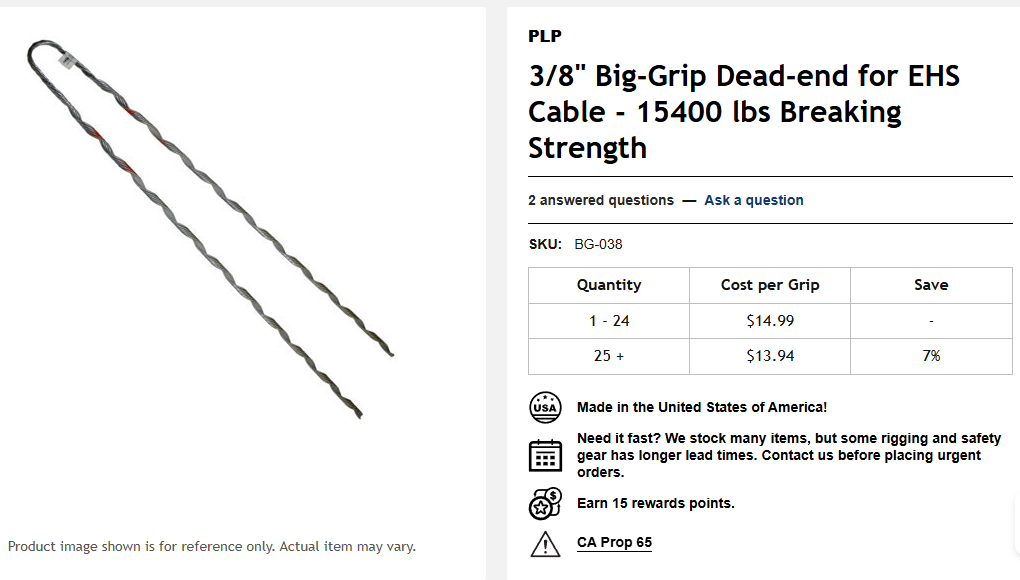

Other components one needs are properly sized thimbles as per the specs of the particular BGDE (very important), properly sized galvanized turnbuckles (corresponding to the strength of the stay), and the appropriate galvanized shackles (their pin size must match the hole in the chain plate). I went with European-made Van Beest Green Pin products wherever possible because they are made by a reputable company and a lot of the cheaper stuff you find on the internet is of questionable provenance. Right now, the prices I see for the turnbuckles I used for my 3/8” wire (5/8″ x 6″ 3180lb Work Load Limit Galvanized G-6311 Eye and Eye Turnbuckle) hover around USD 50, which is twice what I paid two years ago (which coincidentally lines up with the tariffs charged by the Trump regime). American-made might now be cheaper. Even so, this is substantially less than what it costs to get your hands on a comparable Hayn bronze and stainless turnbuckle. At Rigging Only, such turnbuckles with a “T-bolt” toggle cost USD 175; at West Marine they are USD 215.


All told, building a shroud from standard stainless rigging components costs more than five times as much as making one out of galvanized steel as outlined above.

Mast tangs


For my project, the mast tangs were the trickiest part because they had to be custom made. Basically, the idea is to make fittings that will accommodate the loop or eye of the Big-Grip dead end like a thimble. This means two things: the cylindrical shape of the seating surface, as created by the groove, must be the same diameter as specified for the thimble of the Big-Grip dead end; and this cylinder – and thus the groove – must match the angle between the stay and the mast to achieve the proper stay alignment. It is also important to ensure that the fitting sits flush against the mast and that the nut and head of the through-bolt securing the fittings to mast seat properly on the outside surfaces of the fittings. All this is easier to understand by looking at the drawings and photographs. For Momo’s lower shrouds, the fittings needed to accommodate two cables. I designed the fittings using Freecad software, which involved a bit of a learning curve but was fun. I brought the drawings to my favorite metal working shop in Guaymas, and they made three sets out of solid 6061 aluminum for around USD 660.


Finally, a word about vendors and the people I worked with. I bought most the materials for the project from US Cargo Control and Holloway Houston. They were very helpful and easy to communicate with by email. John Barbour, a product support engineer at Performance Line Products, responded graciously to my queries as to the suitability of Big-Grip dead ends for my purposes.
Part Two of this project description will explain how the rig was assembled at anchor. And it will also address the elephant in the room: corrosion. The longevity of a galvanized rig ultimately depends on how well you can protect it from rust. At the moment, I am using two different methods. Most of the rig has been effectively coated with an epoxy polyamide paint (as recommended by the American Galvanizers Association). However, there is too much movement at the ends of the cables for the epoxy to hold. Thus I have been periodically spraying these areas with corrosion protectant (Boeshield T-9; Yamashield Rust & Corrosion Protectant). But I have a few other promising options in mind.
Leave a Reply